Roberta Muldoon
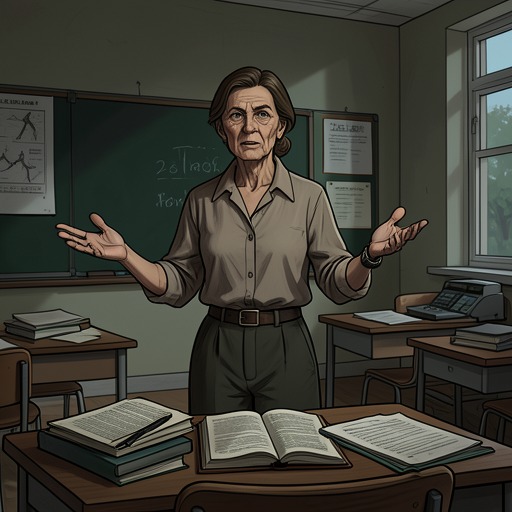
The World According to GarpRoberta Muldoon is a former professional football player whose transition from Robert Muldoon to life as a woman unfolds alongside her work with Jenny Fields and the Fields Foundation. Physically imposing, articulate, and fiercely capable, she becomes both a target of public prejudice and a steady source of care for the people around her. Her arc extends beyond the controversy that first made her visible: at Dog’s Head Harbor she turns athletic force into guardianship, friendship, and sustained civic responsibility.
Identity and Background
Formerly Robert Muldoon, Roberta had been a standout tight end for the Philadelphia Eagles, wearing No. 90. After a successful sex-reassignment operation, her weight fell from 235 to 180 pounds; estrogen also reduced some of her former strength and endurance. Her football knowledge, however, remained intact. The operation followed a period of recovery from knee surgery in a Philadelphia hospital, during which she read Jenny Fields’s book and found in it the courage to pursue transition.
Roberta’s transition was a process rather than a single dividing line. Before surgery, she spent months wearing women’s clothing and wigs, while still going out in the morning as Robert. She paid for the operation through fees from speeches to boys’ and men’s clubs. As estrogen changed her body, she stopped that circuit and began appearing publicly as Roberta in conservative wigs and mannish suits. By the time she discusses her life with Garp, she describes having the same genitalia and urological equipment as most women, while being unable to conceive, ovulate, or menstruate. Jenny reassures her that many women share the latter conditions.
Roberta explains that she had long understood herself as a woman: in her dreams she was a woman being loved by a man, never a man loving another man. Her account also records conflict with women who urged her to remain a gay man rather than transition, warning that a woman would be vulnerable to exploitation. Roberta calls them cowards, though Garp recognizes that she herself has repeatedly been taken advantage of. She can be dismissive of other minorities and critical of the lesbian women staying at Dog’s Head Harbor, a contradiction that sits uneasily beside her own experience of exclusion.
Public Controversy and Jenny Fields
Jenny’s newest colleague, Roberta becomes a public figure when she claims television networks have agreed not to hire her as a football commentator. Jenny supports her case, arguing that Roberta’s expertise has not diminished with estrogen and that her intelligence and command of football would make her better than the usual commentators. Support from college campuses helps make her a conspicuous figure in the dispute. The controversy shows how her professional knowledge is recognized in principle but contested when joined to her gender history.
Roberta worships Jenny, whose book helped make her transition possible. She also becomes part of Jenny’s daily life and accompanies her on visits to Garp. Garp likes Roberta: they talk football and play squash, where her greater strength and athletic skill often win the early games, though her stamina eventually gives way. He prefers his mother’s visits when Roberta comes too. Roberta also spends hours tossing a football with Duncan and promises to take him to an Eagles game. Garp, alarmed by the hostility directed at her and by the prospect of taking Duncan into a crowded stadium, imagines threats to both of them. The hate mail sent to Roberta and Jenny makes that anxiety less abstract: some correspondents attack their lives and identities with extreme hostility.
Roberta’s public case against the networks eventually loses its hold on her, but her involvement in Jenny’s work deepens. When Garp is asked to educate men about women’s needs, Roberta is torn: she shares Jenny’s purpose, doubts Garp will do the work well, and knows she could do it herself. She agrees to work with him, insisting that he will be in charge but that she will advise him and point out his mistakes. Her role is not simply to represent a cause; she is an experienced critic and collaborator who can challenge Garp directly.
Friendship, Care, and Physical Force
At Dog’s Head Harbor, Roberta lives with Jenny through difficult periods of her transition. She had struggled to live alone and with several men, and she returns to Jenny’s house when the Garps move in. The mansion is already a place where women recover from hardship; Roberta’s own experience becomes part of its accumulated history. For Duncan, recovering from the loss of his right eye, she is a companion who adapts her care to his needs. When a game of catch ends with the ball hitting him in the face, she abandons it and draws football plays in the sand instead, recalling her career as Robert Muldoon. She tells him stories of touchdowns, dropped balls, penalties, and hard tackles, but changes the subject when one account touches on a blind-side hit, mindful of the child’s own permanent blind side.
Roberta’s strength is also an immediate form of protection. When a man insults Jenny on the porch, Roberta brings him down with a football-style block before he can continue. The force of the intervention leaves him unable to rise easily, and Jenny tells her it was too hard. Roberta responds by going to fetch Laurel, the man’s partner. Later she and Garp help carry him to his car. The episode exposes a tension in Roberta’s conduct: she can act as a formidable defender, but the same physical capacity can exceed what a situation requires. Afterward she goes to find Duncan and mother him, turning from confrontation back to care.
Her relationship with Garp is grounded in affection, candor, and shared activity rather than romance. They play squash over many years, sometimes injuring one another in the game, and Garp seeks her company even when they disagree. After Jenny is shot, Roberta catches her before she reaches the ground and tells Garp that Jenny never spoke or knew what had happened. In grief, Roberta places blame on men collectively and tells Garp that no man is a woman’s friend. When he pleads that he is her best friend, she still includes him in the accusation. Their friendship survives the exchange, but the scene makes clear how grief and anger can turn a personal bond into a confrontation with the broader violence Roberta sees directed at women.
Roberta also stands by Garp in public situations that expose his own gendered assumptions. When he wants to enter a women-only memorial, she quietly tells him he would have to go in drag. He snaps back with a remark about a chromosome check, immediately regrets it when she winces, and takes her hands until she squeezes his in return. He then turns the insult into an apology and a request for her help with dressing. Her response is simply to agree. The brief exchange shows both the ease with which Garp can wound her and the trust that lets them repair the injury without pretending it did not happen.
Leadership at Dog’s Head Harbor
After Jenny’s death, Roberta becomes a central figure in the work of the Fields Foundation and the life of Dog’s Head Harbor. She runs the mansion with a mixture of strength and maternal attentiveness. She can talk people out of dangerous decisions and, when persuasion fails, physically overpower them. Unlike Jenny, she builds particularly effective ties with the local police. Officers return distressed residents to the house, respecting Roberta’s former football career and the force she brought to the game. The mansion’s care thus depends not only on private compassion but also on working relationships with the surrounding community.
Roberta’s leadership gradually makes Jenny’s estate more publicly respected. She is more outgoing in local affairs than Jenny had been, and spends ten years as chairperson of the school board. She also organizes, coaches, and pitches for the Rockingham County women’s softball team, which becomes the best team in New Hampshire over twelve years. When the governor suggests she undergo a chromosome test before playing in a title game, Roberta challenges him to meet her on the pitcher’s mound and fight. The governor instead throws out the first ball, and Roberta pitches a shutout. The episode turns an attempt to question her eligibility into a public demonstration of her athletic competence.
Roberta is offered a job coaching the offensive line at Steering School, an acknowledgment of her expertise by the same institution that once excluded women. She politely declines, joking that the boys would get her into trouble. Meanwhile, she becomes director of the Fields Foundation, a responsibility she carries with unusual energy. Ellen James gives her the nickname Captain Energy; Roberta replies that Garp was Captain Energy. The exchange recognizes both her own organizing force and the legacy of the friend whose work she continues.
Later Life and Death
Roberta and Garp remain close through repeated squash matches and runs between Steering and Dog’s Head Harbor, a distance of six miles by one road. Their sporting friendship is vigorous enough to leave broken rackets and injuries, but any possible attraction between them is turned into a joke. Roberta’s intimate life, meanwhile, becomes more private and deliberately organized. She has occasional relationships in New York, keeping her visits and encounters separate from her life at the Foundation. She tells Garp that this arrangement is the only way she can manage it, and he accepts it as a reasonable division of power.
As she grows older, Roberta becomes more comfortable with her sex reassignment. Approaching fifty, she describes herself as carrying the vanity of a middle-aged man and the anxieties of a middle-aged woman, adding that the perspective has advantages because she knows what men are going to say before they say it. She runs three marathons after fifty, but problems with burst blood vessels lead her doctor to advise shorter distances. She returns to the familiar six-mile route and sometimes arrives at Helen’s house after a run, where she keeps a robe and changes of clothes. Her athleticism persists, but it adapts to age rather than disappearing.
Roberta dies in the spring when Duncan is hospitalized in Vermont. After wind sprints on the beach at Dog’s Head Harbor, she stops and sits in the porch hammock, complaining of popping sounds in the back of her head or temples. She asks Ellen James to bring iced tea. When Ellen sends a note to ask whether she wants lemon, Roberta calls back that she wants only sugar. The ordinary exchange is the last recorded moment of her life: a woman whose public identity was often treated as a controversy remains, at the end, embedded in the routines and relationships of the household she helped sustain.
Narrative Role and Significance
Roberta’s character is defined by the movement between capacities that others treat as incompatible. The former tight end remains physically powerful, but also becomes a caregiver; a woman facing hostility becomes a public advocate; a controversial figure becomes a trusted local leader. The novel does not make her transition a simple conversion from one identity to another, nor does it erase contradictions in her judgments or relationships. Instead, it gives her a long life in which transition, friendship, work, physical limits, and community responsibility coexist.
Her story also shifts the meaning of strength. On the football field, strength meant blocking and endurance; at Dog’s Head Harbor, it means keeping vulnerable residents safe, maintaining institutional ties, and continuing to show up for friends. Roberta’s success is measured not only by public recognition but by the sustained life of the foundation and the respect she earns in the town. By the time she dies, she has outlived John Wolf and most of her lovers, though not Helen, and has become more than the figure whose hiring case once drew national attention: she is one of the people who makes Jenny’s legacy workable in everyday life.